A pair of boots that fits is worth more than a pair that does not, and by the time a boot needs resoling it has usually moulded to your feet. That is the argument for repair: not sentiment, but the fact that the fit is already known and proven over hundreds of kilometres. The reason repair sometimes fails has nothing to do with the sole.
Sole construction decides what is possible
Boots are attached to their soles in a few different ways, and the method determines whether a repair is realistic.
- Cemented soles are glued to the upper. This covers most modern hiking boots and is the cheapest way to build. A cemented sole can usually be replaced once - sometimes twice - by a repairer who can remove it, clean the surface and bond a new one. Each resole takes a little material with it.
- Stitchdown and stitched constructions have the upper turned out and stitched to a midsole or insole, often with additional cementing. These are the most repairable boots, because the sole is attached with something a person can undo and redo. They are heavier, stiffer and usually more expensive.
- Injection-moulded and directly moulded soles are bonded by machine as part of the manufacturing process. They are strong and light, and they are effectively non-repairable once the sole is worn.
- Vulcanised constructions, common on some approach shoes and canvas boots, sit in between and depend on the specific maker’s process.
Leather climbing and mountaineering boots are often built for repair, because their users expect it. Lightweight synthetic boots usually are not. If repairability matters to you, it is worth checking before you buy, because almost no product page mentions it.
The midsole is the real limit
Between the upper and the outsole sits a midsole: foam, polyurethane or a composite that provides cushioning and structure. It degrades in ways the sole does not.
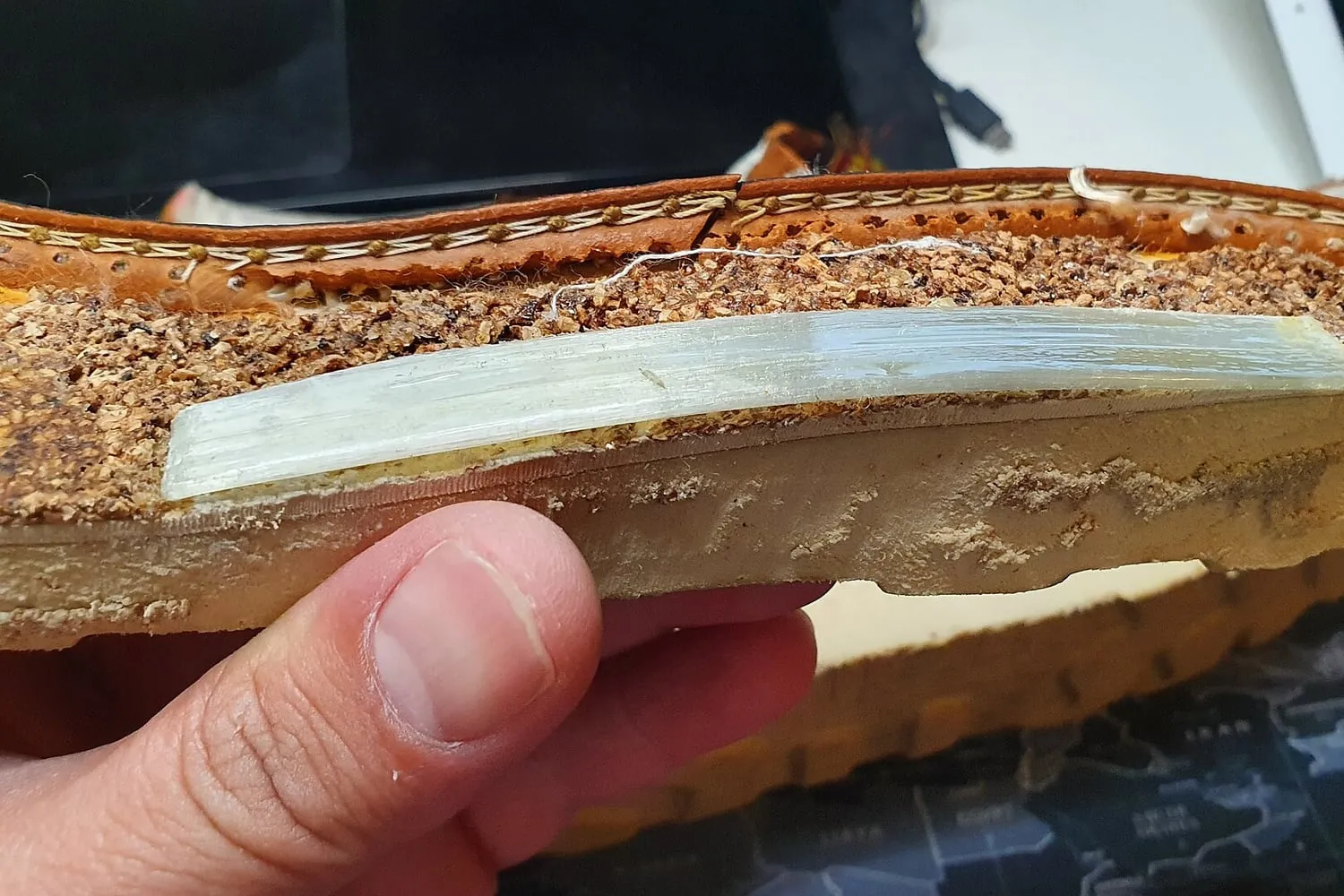
Foam midsoles compress and lose their cushioning with use, and they do not recover. Polyurethane midsoles can crumble and hydrolyse with age, especially if the boots spend years in a warm, humid cupboard. When a midsole has collapsed or begun to disintegrate, there is nothing left for a new sole to attach to or to sit on, and a repair shop will usually decline the job.
This is why a boot can look fine and still be finished. If the sole is worn flat but the midsole is sound, resoling is straightforward. If the midsole has gone, the boot is done - and no resole will bring the cushioning back.
The membrane
Most lined boots contain a waterproof membrane, and membranes are the least repairable component. Once a membrane is cracked, delaminated or punctured - often by grit working through from the inside, or by a crease that has been flexed for years - there is no reliable fix.
The usual outcome is a boot that is comfortable and structurally sound but no longer waterproof. That is not necessarily the end. Many people keep such a pair as dry-weather boots on the grounds that they have already paid for them, and simply stop using them in the wet. If you walk in wet conditions all year, though, a failed membrane is the point at which the arithmetic starts to favour replacement.
What can be repaired
Resoling replaces the outsole and, where needed, part of the midsole. Ask what sole unit will be fitted, whether the tread pattern suits the ground you walk on, and whether the repairer will reuse the original last shape. A good resole keeps the boot’s flex characteristics; a poor one produces a stiff plank.
Rands - the rubber band wrapped around the toe or the whole upper - protect the toe from rock. Rands wear through, and a boot with a split rand will start to lose its upper at the front. Rand replacement is a standard repair for mountaineering boots and worth doing early.
Hardware. Eyelets, hooks, speed-lace loops and the laces themselves are all replaceable, and a worn eyelet that has started to cut the lace is a cheap fix.
Upper damage. Small cuts, split stitching and straps can be repaired, particularly on leather boots. Repairs to laminated or welded synthetic uppers are more difficult, and a repairer may decline them.
What you can do yourself
Not everything needs a specialist:
- Laces are the most common failure and the cheapest to fix. A spare pair in a rucksack has saved many long days.
- Footbeds and insoles should be replaced when they flatten or stop supporting your arch. If you use custom footbeds, transfer them to the new pair when the boots eventually go.
- Leather treatment. Clean mud off while it is still soft - dried mud holds grit that abrades stitching and leather - and apply conditioner sparingly and occasionally. Over-treating leather softens it and stretches the boot, which is worse than leaving it alone.
- Re-waterproofing leather uppers with a suitable wax or cream keeps the leather from absorbing water and slows the breakdown of the cement holding the sole on.
- Drying. Never dry boots on a radiator, in front of a fire, or on top of a stove. Heat softens the cement bond, hardens leather and damages the membrane. Stuff them with newspaper and dry them at room temperature, away from direct heat.
Repair or replace?
A short checklist. Repair usually wins when:
- the sole is worn but the midsole is sound;
- the upper is intact and the fit is good;
- the boot is a stitched or cemented construction a repairer will work on;
- the repair cost is a clear fraction of a new pair of comparable boots.
Replacement usually wins when:
- the midsole has collapsed, crumbled or separated;
- the membrane has failed and you walk in wet conditions;
- delamination or splitting covers a large area of the upper;
- the boots have never been comfortable and the fit has always been wrong;
- the boots have been resoled more than once and the upper is now distorted.
A final point about buying: if you want a pair you can keep for a decade, buy a boot that a repairer can rebuild, and accept that it will be heavier and cost more than a moulded-sole alternative. Repairability is a design decision made at the factory, long before you walk into the shop, and no amount of aftercare can add it afterwards.